The Radio WOrkbench.
When I was a little kid, probably 8 or so, my older sister gave me one of those “Radio Shack 50-in-1” electronic project kits. I was hooked.
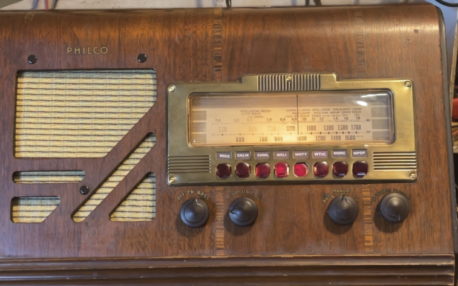
A few years later a family friend gave me an old radio he’d had since the second world war. It was a Philco model 39-25 tabletop. I listened to shortwave stations on it almost every night when I was in high school. At one point the hum became loud enough that I pulled the chassis and replaced one of the electrolytic capacitors. The easiest thing to do seemed to be to disconnect the big can that was oozing some sort of of crystalline substance from around the top, and solder in a new one under the chassis. I would many years later thank my teenage self for having the presence of mind (or dumb luck) to do it this way. I still have this radio today, still one of my favorites and now completely restored electronically.
After I got out of high school I landed a series of jobs as an apprentice technician, beginning in a shop that did modifications of panel meters for custom applications as well as repairs of multimeters like the venerable Simpson 260 and Triplet 630 series. I spent time as a service tech at a small TV shop in York Beach, Maine repairing televisions, stereo equipment, and installing rooftop antennas. (Remember those?)
You never know what starts a young person on their way to a passion, a career, or a crazy hobby.
At about 20, having developed an appreciation of great audio equipment, but without a prayer of being able to afford any of it, I started hanging out at a high-end stereo place in Portsmouth New Hampshire quite a bit. One day the sales guy who had figured out that I had could no more afford any of what he was showing me than fly to the moon in my ’66 Rambler American asked me what I did for a living.
“I repair TVs”, was my matter-of-fact response.
“Can you repair stereo equipment?” he asked.
“Sure . . . I do that too.”
It turns out that the shop owner, who was also their tech, had “other life distractions” and they were at that point in time experiencing something like a two-month backlog. Soon I found myself inside McIntosh amplifiers, Sansui and Yamaha receivers, Tandberg tape decks, and just about anything else one could imagine in the world of high-fidelity electronics in the mid 1970s. I spent the next several years of my life working a combination of sales and service jobs at various establishments, as well as two years of traveling around the United States as the EPI “Speaker Clinic” dude demonstrating the advantages of their speakers over whatever you brought in to have tested. A great gig for someone in their early 20s.
“A blockquote highlights important information, which may or may not be an actual quote. It uses distinct styling to set it apart from other content on the page.”